Led by Dr. Danny Miller, the Genomic Discovery Initiative at the University of Washington uses advanced long-read DNA sequencing to better understand methylation signature variation.
This technology, unlike most clinically available genetic testing, can detect the pattern of methylation as well as evaluate the DNA sequence, allowing researchers to discover associations between DNA variants and methylation status.
-
Contact the research team at: MillerLabResearch@uw.edu to schedule a brief screening and consent discussion.
-
What is a methylation signature?
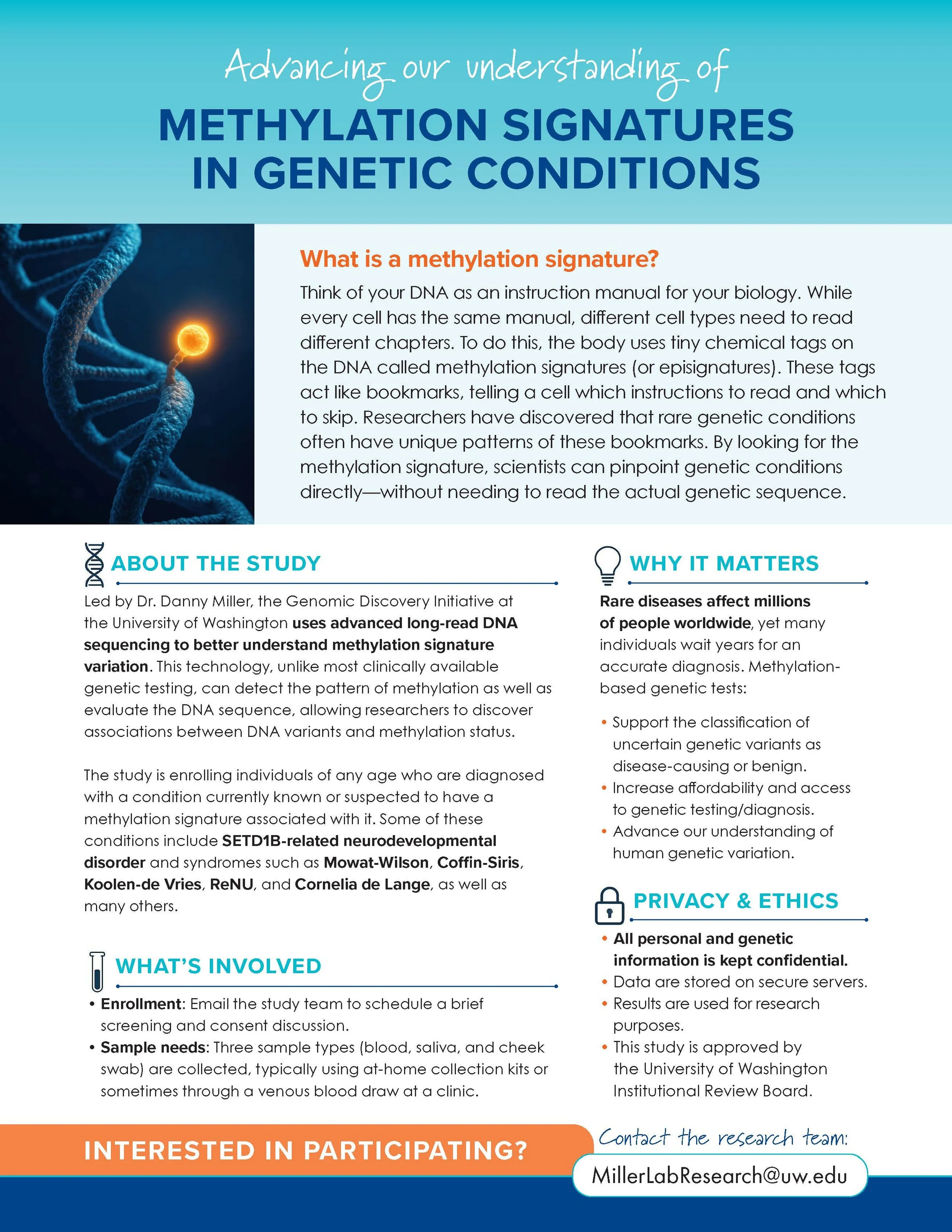
Think of your DNA as an instruction manual for your biology. While every cell has the same manual, different cell types need to read different chapters. To do this, the body uses tiny chemical tags on the DNA called methylation signatures (or episignatures). These tags act like bookmarks, telling a cell which instructions to read and which to skip. Researchers have discovered that rare genetic conditions often have unique patterns of these bookmarks. By looking for the methylation signature, scientists can pinpoint genetic conditions directly—without needing to read the actual genetic sequence.
-
Sample needs: Three sample types (blood, saliva, and cheek swab) are collected, typically using at-home collection kits or sometimes through a venous blood draw at a clinic.
-
Rare diseases affect millions of people worldwide, yet many individuals wait years for an accurate diagnosis. Methylation-based genetic tests:
• Support the classification of uncertain genetic variants as disease-causing or benign.
• Increase affordability and access to genetic testing/diagnosis.
• Advance our understanding of human genetic variation.
-
The study is enrolling individuals of any age who are diagnosed with a condition currently known or suspected to have a methylation signature associated with it.
This includes ReNU syndrome, as well as many others.
-
We are not aware of any participation costs to patient families.
-
-
Is this study associated in any way with the n-Lorem Foundation?
No, this study is not affiliated nor connected with the n-Lorem Foundation.