GestaltMatcher
GestaltMatcher.org
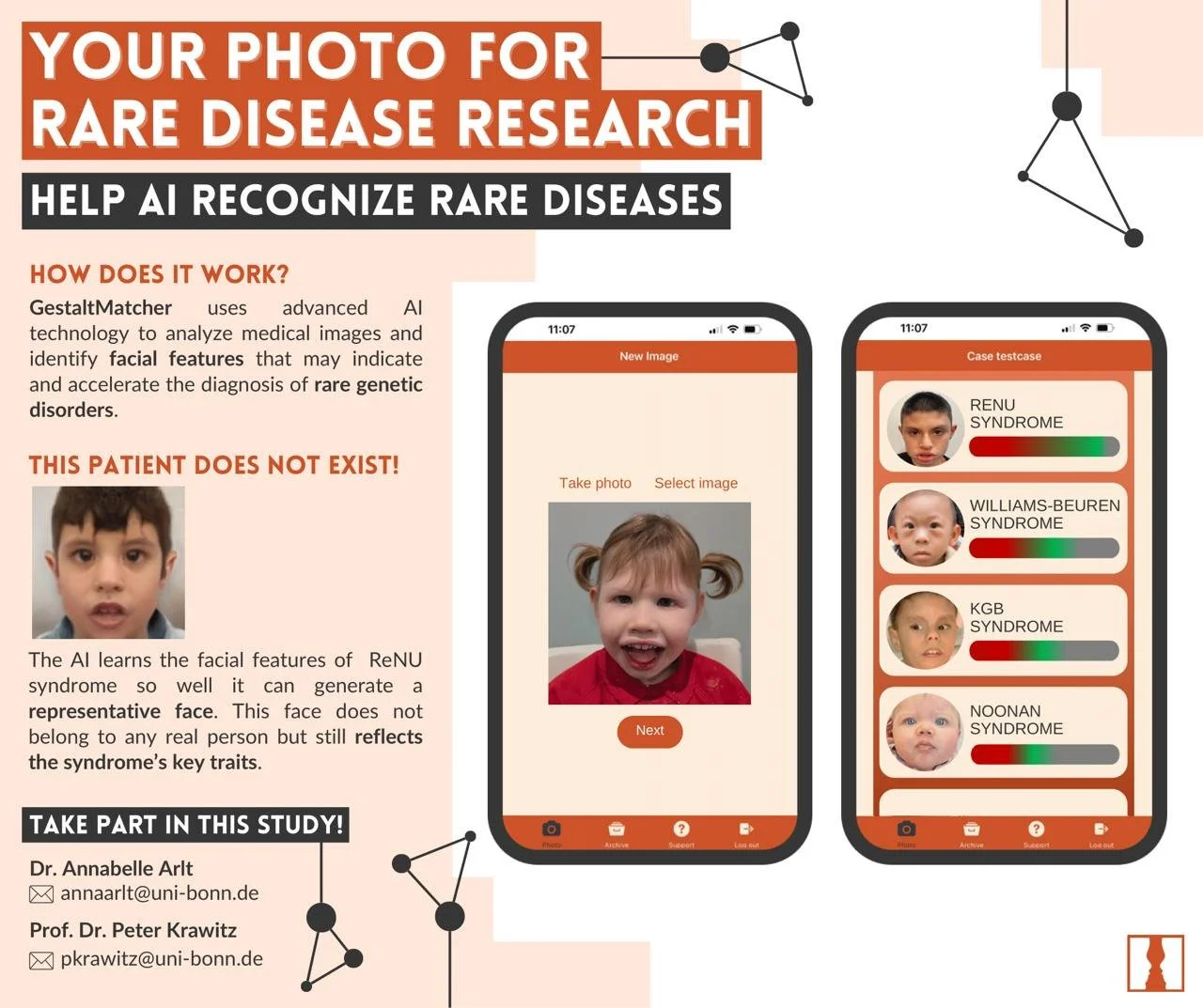
GestaltMatcher uses advanced 2D Al technology to analyze medical images and identify facial features that may indicate and accelerate the diagnosis of rare genetic disorders
-
Email Dr. Annabelle Arlt annaarlt@uni-bonn.de or Dr. Peter Krawitz pkrawitz@uni-bonn.de to enroll. The research team will provide next steps for submitting the required clinical information and medical photographs.
-
GestaltMatcher database (GMDB) is an artificial intelligence-based research tool designed to recognize characteristic facial features associated with rare genetic disorders.
Using advanced computer vision and next-generation phenotyping, GestaltMatcher analyzes medical photographs alongside clinical and genetic information. The goal is to help improve recognition of rare syndromes, support diagnosis, and strengthen the ability of researchers and clinicians to distinguish one genetic condition from another.
For ReNU syndrome, participating families can help researchers better define the facial features associated with the condition and improve AI models that may eventually help identify other people with ReNU syndrome who are still undiagnosed.
The GestaltMatcher Database is a curated research resource that includes medical images, clinical features described using standardized HPO terminology, and molecular diagnoses when available. Its data infrastructure follows FAIR principles, meaning the information is designed to be findable, accessible, interoperable, and reusable for appropriate research purposes.
-
Global / Remote Participation
Families can participate from anywhere. GestaltMatcher’s web services are operated on secure servers located in Germany, and the GestaltMatcher Database is maintained by the Arbeitsgemeinschaft für Gen-Diagnostik e.V. (AGD).
Participation does not require families to travel to Germany. Contact the research team for instructions on remote enrollment and submission of photographs and clinical information.
-
Your photograph can become part of the data researchers use to help AI recognize ReNU syndrome more accurately.
By contributing to GestaltMatcher, families may help researchers:
Better characterize the facial features and overall phenotype associated with ReNU syndrome
Train and improve AI-based tools used to recognize rare genetic disorders
Help clinicians distinguish ReNU syndrome from other conditions with overlapping features
Improve interpretation of genetic findings when combined with clinical information
Build a stronger research dataset for a newly identified condition
Potentially help other undiagnosed individuals reach the correct diagnosis more quickly
For a condition as newly recognized as ReNU syndrome, every well-characterized participant adds valuable information. A larger and more diverse dataset can help researchers understand the full range of how ReNU syndrome presents across individuals.
-
Individuals with a confirmed ReNU syndrome / RNU4-2 diagnosis may be eligible to participate.
Participation involves contributing medical photographs and associated clinical information so researchers can study facial and phenotypic patterns associated with ReNU syndrome.
-
-
-